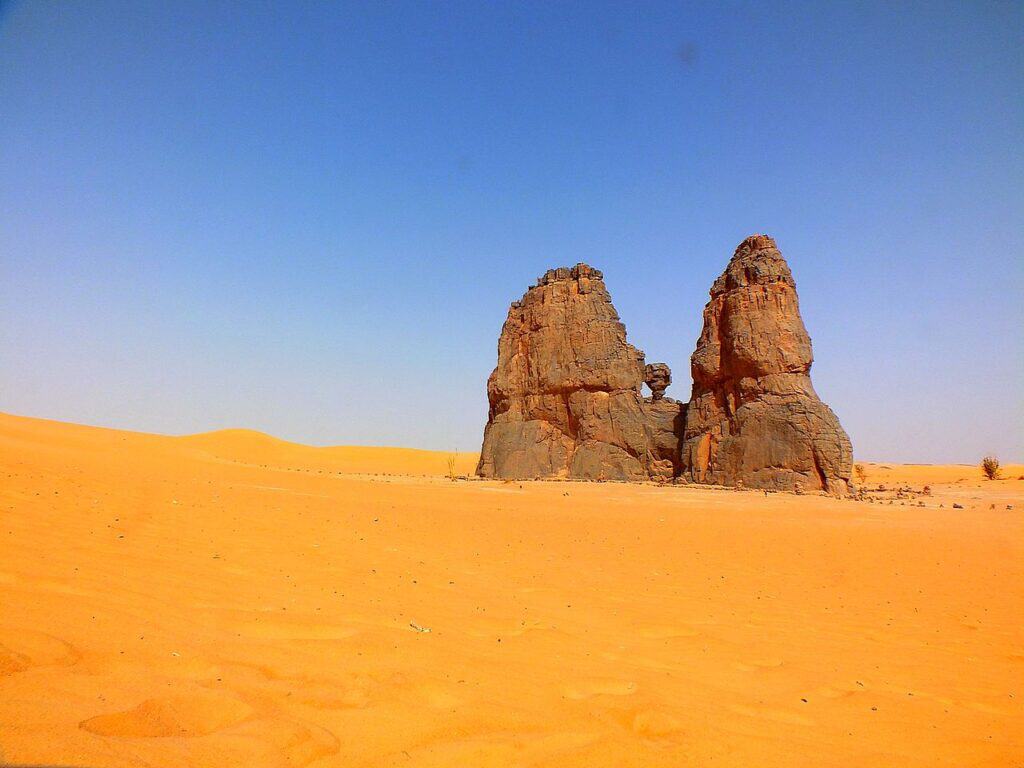
The ginormous monolith that bears the ancient rock engravings
photography by: Akli salah/ Wikimedia Commons

Spanning across a whopping 9.2 million square meters, the Sahara easily reigns as the largest desert on Earth. What seems like an endless, desolate expanse is, in reality, teeming with life and history. Scattered across this arid landscape are lush oases and remnants of civilizations long gone. One of the most striking of these relics can be found in southern Algeria, where for over 7,000 years, a series of intriguing petroglyphs has adorned the face of a towering boulder.

By: Kefah Alfardan
Date: 17:58 25.09.24
Last Update: 17:39 26.09.24
The Neolithic era marked a turning point in human history. No longer simply hunting and gathering, people began to settle down, heralding the rise of agriculture, livestock breeding, and early communities. This period brought deep societal changes, as humans adapted to a more structured lifestyle.
With the mastery of farming and animal domestication, people also began to record their experiences through art, leaving behind detailed images of their daily lives and the natural world. Standing out among the vestiges of this era are the rock engravings scattered across North Africa’s central Sahara region.
Roughly 20 kilometers south of the oasis town of Djanet, within the sun-scorched desert of southeastern Algeria, stands a large monolith known as La vache qui pleure, or The Crying Cow. This massive rock formation, rising from the sands, boasts an awe-inspiring cluster of Neolithic art.
The carvings, etched into the stone over 7 millennia ago, depict a small herd of cattle, patiently waiting by a dry basin. It’s the tear falling from the eye of one cow that earned this site its evocative name - the Crying Cow.
Carved in bas-relief, the cows appear with a lifelike precision, their forms standing out from the rock as if still part of the ancient herd. The deep, finely chiseled grooves display a level of skill that has long baffled researchers.
Interestingly, the weeping heifer has sparked countless interpretations and myths. Some assert that the tear represents the animal in a state of dehydration, a reference to a drought that left the landscape barren and the cattle with no water to quench their thirst. Others, however, believe it might be a mark on the cow, something left unexplained by the artists who once roamed this land.
Local Tuareg legends suggest the petroglyphs tell of herds once brought to this region, where they flourished until the rains ceased. The cows, they say, shed tears when the water dried up, now forever preserved in stone. Though the true story may never be known, this site offers a rare glimpse into the lives of our ancient ancestors, who laid the groundwork for the modern civilization that now reigns supreme worldwide.

The ”Crying Cow”
photography by: zobeidi mohammed khemisti/ Wikimedia Commons